Ziya Teknik QR channel: bringing in-store customers online
One QR code on the counter turns the moment of payment into a follower and a Google review. Customers who visit the shop no longer vanish once they walk out the door.
- Role
- Idea, page design, QR and signage, tracking
- Period
- Sep 2026
- Platforms
- Astro, Umami, Google Business Profile, Instagram
- 1 scan Payment, follow and review on one screen
- 30% Of the QR can be damaged and still scan (level H)
- A5 Print-ready sign, vector PDF
Context
Ziya Teknik is a workshop: customers bring their device into the shop, come back to pick it up when the job is done, and pay. In digital marketing, most of the budget goes into getting these people through the door; but once they were in, no connection was made with them. A happy customer neither followed the Instagram account nor left a Google review. The moment they walked out, they were gone.
Yet for a local business, these people are the most valuable digital asset there is: people who actually used the service and were happy with it. Their reviews affect ranking on Google Maps, and their follows keep the business in mind the next time something breaks.
The idea: turn the moment of payment into a channel
Asking customers at the counter “would you follow us, would you leave a review?” doesn’t work; it’s a favor, and most people say “sure” and forget. Instead, I found a moment the customer already has to go through: payment.
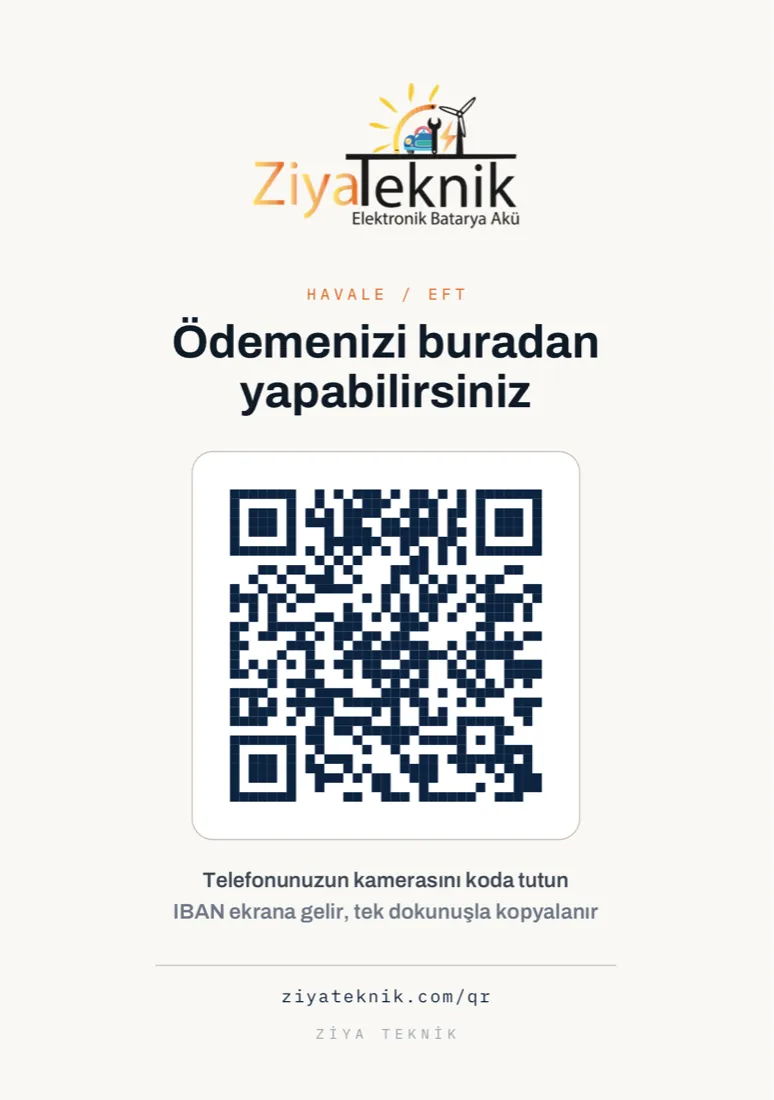
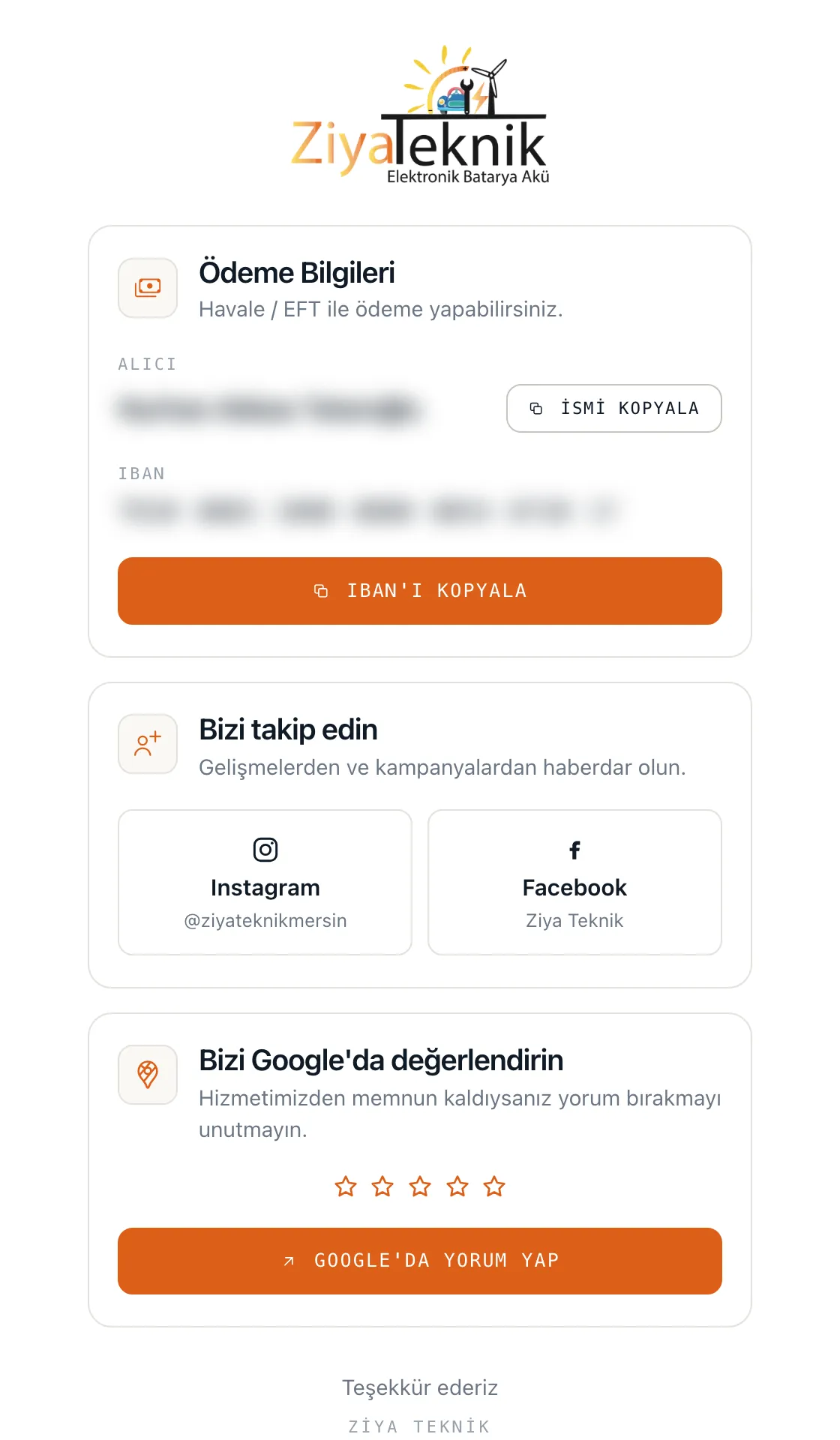
A customer paying by bank transfer needs to get the IBAN somehow. Now there’s a sign on the counter for that: “You can make your payment here.” The customer scans the code, the IBAN appears on screen and copies with one tap. Right below, on the same screen, are the Instagram and Facebook accounts, and at the very bottom a “Review us on Google” button.
So I didn’t invent a separate reason to pull the customer into a digital channel; I placed it inside the moment they already have their phone in hand. As soon as the payment is done, a customer who has just finished their errand — and is most likely satisfied — is standing in front of the review button.
What I did
1. The page: one screen, three jobs
ziyateknik.com/qr is a plain page, separate from the rest of the site. No menu,
no footer, nothing else to distract; the order is deliberate:
- Payment details. Recipient name and IBAN, readable in groups of four; the copied value has no spaces, so pasting it into a banking app doesn’t throw an error.
- Follow. Instagram and Facebook side by side, each one tap away.
- Google review. A button that goes straight to the rating screen.
The page is closed to search engines (noindex, robots.txt, and left out of
the sitemap). I wanted people to arrive here only by scanning, not by searching;
there’s also no need for the IBAN to float around in search results.
2. QR and sign: built for shop conditions
The shop is a workshop: dust, greasy hands, a counter that gets the sun. I made the QR with that in mind. The error correction level is H, meaning the code still scans even if 30% of it is scratched or dirty.
I prepared the sign as an A5 PDF that can go straight to the printer: fonts embedded, QR in vector, no quality loss when scaled up to A4. The sign’s wording carries the same idea; the headline doesn’t say “follow us” but “you can make your payment here”. Below it is a single line of instructions: hold up your camera and the IBAN appears on screen.
3. Tracking: separating offline traffic
The page’s four main actions are each counted as separate events in Umami: IBAN
copy, Instagram, Facebook and Google review. All of them carry a konum: qr
(location) tag, so they don’t mix with other clicks on the site: you can see how
many people scanned the code in the shop and paid, and how many of those then
tapped the follow or review button.
Normally, a walk-in customer leaves no trace on the digital side. With this channel, offline customers became a measurable audience for the first time.
Result
The channel went live in September 2026. The single action needed to get the payment details now also takes the customer to Instagram and to a Google review. A customer brought into the shop with ad budget leaves something behind for the business’s online presence on the way out: a follow, a review.
The rest of the site is on the Ziya Teknik website page, and the ads side is on the Paid Ads page.
Screenshots of the work
The numbers are left exactly as they appear in the dashboards.
If you have a question about this project, drop me a line.
More in Websites
- Ziya Teknik: from Wix to Astro, a service site that gets found I rebuilt the Wix site from scratch with Astro. Seven services written in the language of search, an 83-question FAQ marked up with schema, and every phone tap tracked. Read the case
- This site: not a portfolio, a proof file I designed and built the site you’re reading with Astro. Every number has a screenshot next to it, the n8n workflow can be explored in the browser, and adding a new project is a single markdown file. Read the case