Ömer Tataroğlu Performance Marketing & AI Automation

Performance Marketing & AI Automation

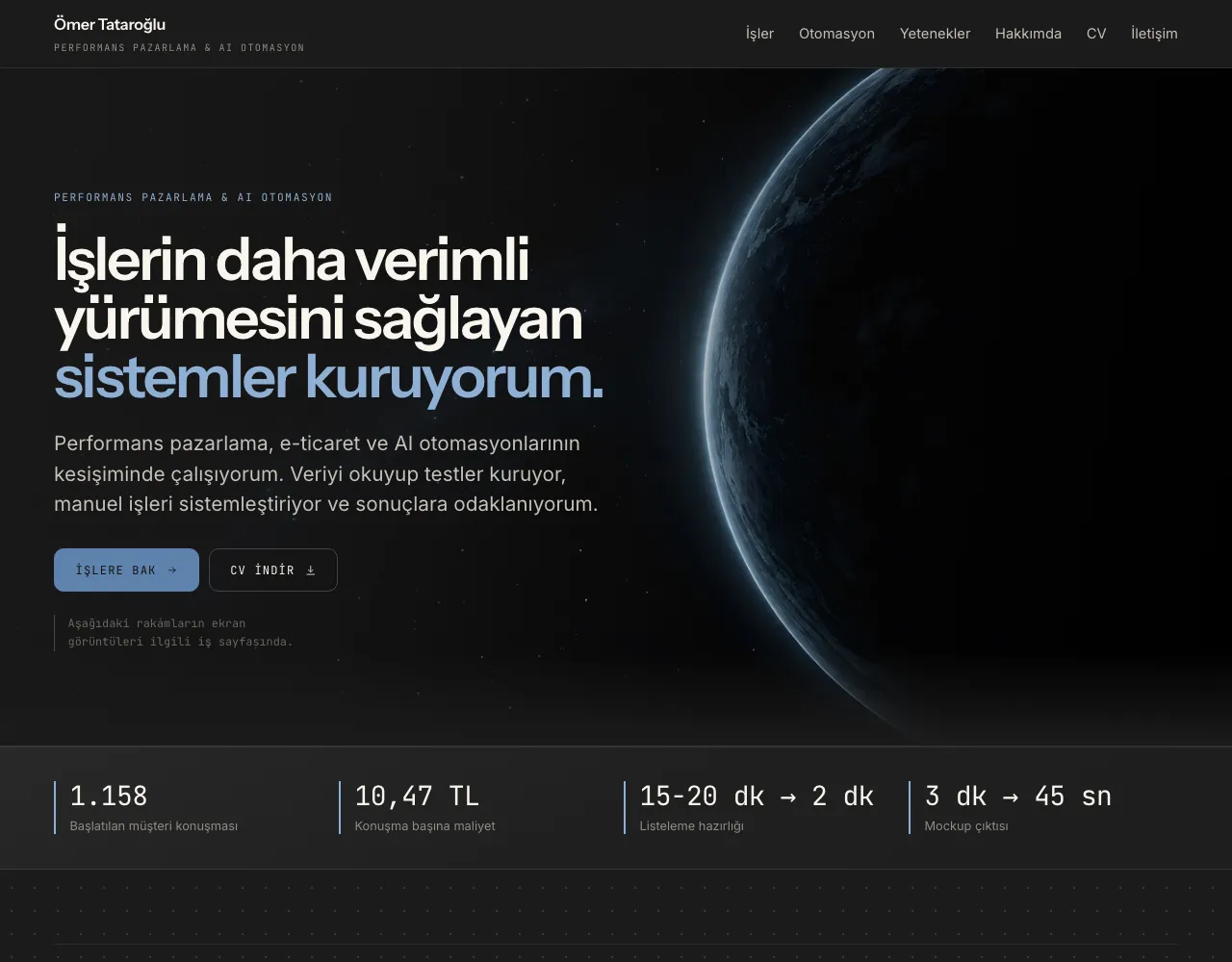
I build systems that make work run more efficiently.

I work where performance marketing, e-commerce and AI automation meet. I read the data, set up tests, turn manual work into systems and keep my eye on results.

Tools I use

  • Meta Ads
  • Google Analytics
  • n8n
  • Claude Code
  • Google Tag Manager
  • ChatGPT
  • Search Console
  • Gemini
  • Google Business Profile
  • Midjourney
  • Photoshop
  • Google Sheets
  • Astro
  • Cloudflare
  • Netlify
  • GitHub
  • Telegram
  • Etsy
  • Shopify
01 Work

What I’ve been working on.

Websites, paid ads and AI automation. Each project page has the screenshots and a step-by-step account of what I did.

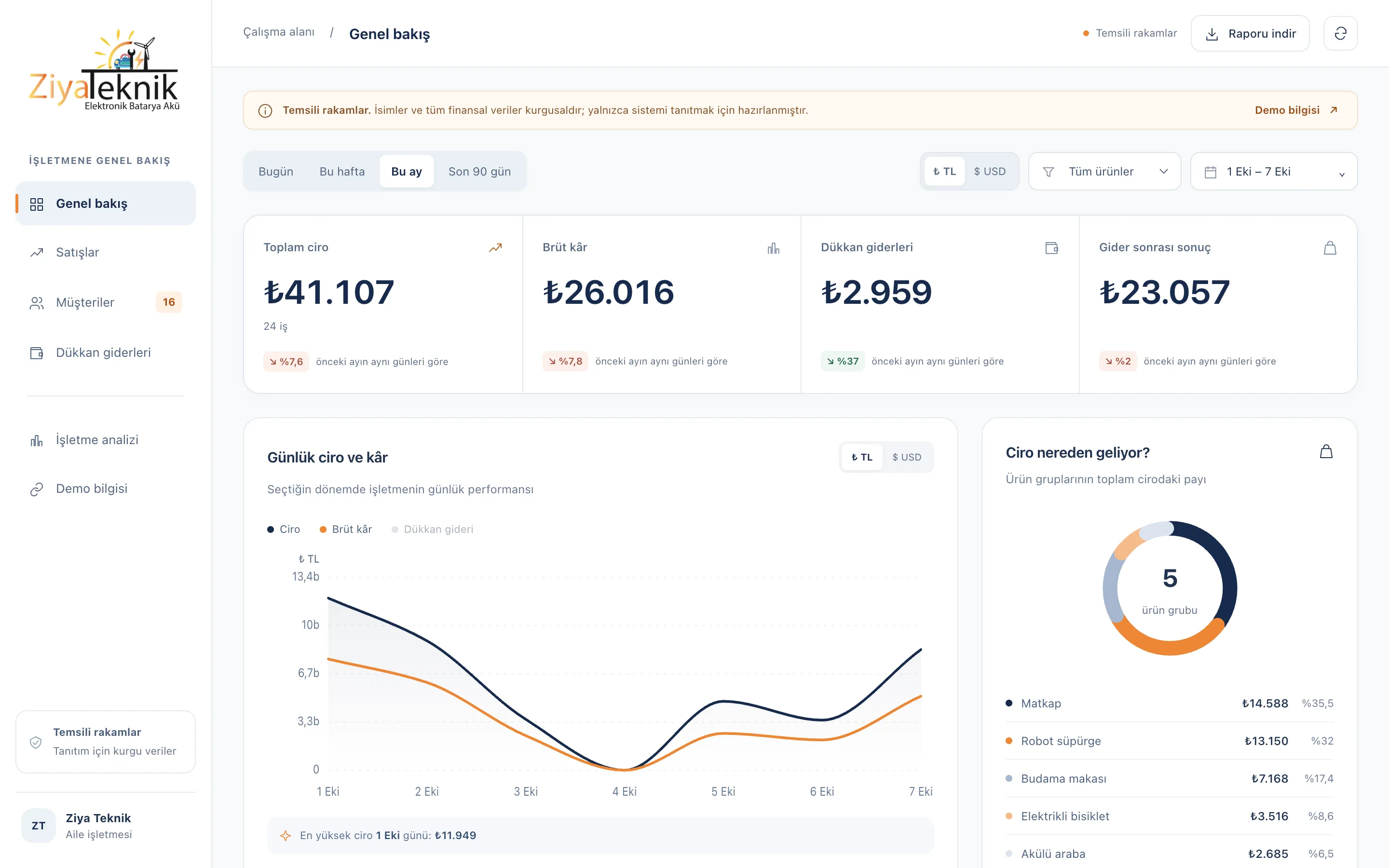
Ziya Teknik – Günlük Meta Reklam Raporu 15 node · n8n · Meta API, Gemini, Telegram
true false

Drag to explore · click a node

Reporting

A morning ad report with per-ad-set alerts

Yesterday’s Meta ad results land in Telegram at 08:00 every morning. Any ad set that got more expensive, spent without bringing in a message, or saw its frequency climb while costs rose is flagged on the first line.

Read the case
Etsy Listing Manager 41 node · n8n · Sheets, Drive, Etsy API
done loop true false true false true false true false true false true false done loop true false

Drag to explore · click a node

AI Automation

Etsy printables: a production and listing pipeline built on three automations

Mockups went from 3 min to 45 s, listing prep from 15–20 min to 2 min.

Read the case
02 AI & Automation

I try to automate the work that repeats.

Most of marketing is operations. These workflows cut long tasks short.

Listing prep — Listing Data Architect GPT

n8nGPTGoogle SheetsEtsy

Before

Filling in a listing’s title, tags, description, attributes, price and SKU one field at a time took 15–20 minutes.

After

A GPT I built pulls the SEO data, it lands in Sheets and gets matched by SKU, and an n8n workflow prepares the listing on Etsy as a draft. I deliberately kept publishing manual.

15–20 min 2 min

Input

  • Product image
  • SKU (from the file name)
  • Etsy Marketplace Insights CSV
  • Attribute reference table

What the rulebook checks 7 sections

A selection from the rule set I wrote; I don’t share the full text.

01 Visual accuracy 4
  • A species it isn’t sure of doesn’t get named: “flower”, not “tulip”
  • A “looks like” in the summary can’t turn into a firm claim in the title
  • The title is built around what fills most of the image, not what catches the eye first
  • The room, frame and lighting in the mockup don’t count as evidence
02 Keyword evidence 4
  • Metrics come only from that run’s Marketplace Insights file
  • A phrase that appears verbatim in the list is VERIFIED; one that doesn’t is DERIVED and its metric stays UNKNOWN
  • No made-up search volumes, competition scores or percentages
  • No single weighted score; search volume never outranks visual accuracy
03 Title 5
  • 100–140 characters
  • The first ~40 characters say what the product is, in the buyer’s words
  • Tag 1 appears in the title verbatim and unbroken
  • At most one broad-reach term; the rest is specific to this image
  • Commas are the only separator — “|” and “•” are banned; it has to flow when read aloud
04 Tags 4
  • Exactly 13 tags, each 20 characters at most
  • A generic one-word tag doesn’t count as a working tag
  • The same root appears in no more than 3 tags
  • Two similar images in the same batch can’t share Tag 1
05 Description 4
  • AI-style openers like “Transform your space” are banned
  • At least two of the “Perfect for” points must be specific to this image
  • Delivery details are fixed: 1 PDF, Drive link, 5 JPGs, 300 DPI
  • The description isn’t a second tag list
06 Attributes 3
  • Only active values from the reference table are used
  • Counts are fixed: 1 orientation, 2 colors, 1 style, 5 rooms, 3 subjects
  • If the count doesn’t add up, it isn’t padded with irrelevant values — it’s flagged REVIEW
07 Exit check 4
  • Two states: READY and REVIEW
  • One repair attempt is made before REVIEW
  • A 17-point checklist before export
  • One SKU in REVIEW doesn’t stop the batch

Sheets row — 42 columns

  • Visual Summary
  • Micro Niche · Art Style
  • Etsy Title
  • Tag 1 – Tag 13
  • Etsy Description
  • Color · style · room · subject
  • READY / REVIEW

Columns 1–33 belong to the GPT. Columns 34–42 (price, quantity, folder, listing ID, error, timestamp) are n8n’s — once it opens the draft, it writes the listing ID back to the same row.

Mockup production — Photoshop script

PhotoshopScript

Before

Placing an image into the mockups and exporting it in Etsy’s format took 3 minutes. A 30-image batch meant an hour and a half — and on repetitive work, the more tired you get, the more likely a skipped mockup or a file in the wrong folder.

After

The script I wrote does all the placing and exporting in one go. On 30-image batches it brings the error rate to zero: no skipped mockups, wrong sizes or files in the wrong folder.

3 min 45 s

3× speed

The script places a single source image into every mockup scene in turn and exports it in the format Etsy expects. The finished files appear as the tab strip at the top fills up.

Image generation — prompt generator GPT

GPTMidjourney

Before

I came up with image ideas one at a time; each time I had to rethink what the store was missing and what people were searching for that season.

After

I defined the rule set myself, based on the store’s niche. The GPT looks at what’s being searched that season and produces ideas in batches of 25 prompts.

one by one batches of 25

Input

  • Listing table (store inventory)
  • eRank keyword table

Column names don’t have to match exactly; fields are matched by meaning.

What the rulebook checks 7 sections

A selection from the rule set I wrote; I don’t share the full text.

01 Print realism 4
  • Once in a mockup, the piece should look like a print, not a screenshot
  • Banned: backlit screen, glossy display, LED glare, plastic digital surface
  • Preferred: matte finish, subtle paper grain, natural pigment texture
  • Texture can show but not look dirty — the goal is “a real print”, not “a worn-out poster”
02 Idea selection 4
  • Decision order: store identity → inventory gap → keyword potential → variety → print fit
  • A subject the store already has plenty of isn’t produced again
  • High search volume alone isn’t enough
  • An idea that would print badly doesn’t get priority just because its keyword is strong
03 Keyword use 4
  • Keywords set the market direction; they don’t box in the visual idea
  • Completely different scenes come out of the same cluster
  • Keywords don’t appear as text in the image and aren’t repeated in the prompt
  • A prompt isn’t written like an SEO title
04 Batch mix — 25 prompts 4
  • 10 keyword gap — areas with potential that are underrepresented in the inventory
  • 7 core expansion — extend the core aesthetic with new sub-ideas
  • 5 creative gap — fill missing orientations, colors, subjects and compositions
  • 3 experimental — new sellable micro-niche tests that fit the store identity
05 Style and palette 5
  • Six style families: sun-faded gouache, watercolor, mid-century, oil painting, minimal poster, linocut
  • Colors are muted, sun-faded, dusty or weathered; no neon or plastic saturation
  • A controlled 3–5 color palette; cream / ivory instead of flat white
  • A batch can’t be predominantly blue
  • 3D render, anime, clipart and vaporwave styles are off
06 Composition and figures 4
  • Must read at thumbnail size, with a clear focal hierarchy
  • The background doesn’t compete with the subject; no clutter of extra objects
  • Human figures appear in at most 20–25% of a batch
  • No close-up portraits and no complex hand/finger focus
07 Prompt template 3
  • Every prompt has ten parts: subject, setting, composition, medium, palette, light, texture, print guidance, negatives, aspect ratio
  • Fixed negatives: no readable text, no logo, no frame, no mockup, no glossy display
  • No typography, branded products, celebrity likenesses or imitation of living artists in the image

Output for each idea

  • Prompt No
  • Strategy Type
  • Primary Keyword
  • Keyword Cluster
  • Micro Niche
  • Creative Concept
  • Orientation
  • Midjourney Prompt
  • Selection Reason

Prompts are in English, the batch summary in Turkish. Each idea carries a selection reason — so the gap it fills can be discussed later.

03 Skills

Tools I use.

The ones I actually use day to day. Where and how I used them is covered on the project pages above.

Advertising & creative

  • Meta Ads
  • Creative test design
  • Visual design in Canva

Measurement & analytics

  • Meta Pixel & Conversions API
  • GA4 / reporting
  • Google Tag Manager
  • Reading ad performance data

SEO & local visibility

  • Google Business Profile / local SEO
  • Search Console

AI, automation & web

  • n8n workflow building
  • Claude Code
  • Content and SEO with GPT
  • Midjourney prompt design
  • Photoshop scripting
  • Static sites with Astro

E-commerce

  • Etsy
  • Amazon Seller Central
  • Product research with Helium 10
  • Pricing & margin
04 Process

How I work.

  1. Research

    I try to understand the market, competitors and demand through data. I make a point of not starting from a guess.

  2. Do it by hand

    I do the work by hand for a while. That’s how I see which steps repeat, where the time goes and what can be automated.

  3. Automate

    I quickly turn the repeating step into an automation and set up measurement at the same time; I don’t move on without seeing the result.

  4. Go deeper

    If the result is good, I fill the gaps and extend the setup. If it isn’t, I don’t pour more time into it.

05 About

Me, briefly.

Ömer Tataroğlu

What keeps me in marketing is data: making a decision with numbers I’ve measured, not with a guess.

I started out with Amazon dropshipping. I was twenty; I learned product research, listing and selling, but I didn’t understand the accounting side. When I couldn’t manage cash flow, I had to shut it down. The lesson I took from it: a sales figure on its own says nothing — you have to be able to read the numbers behind it.

I chose digital marketing because I enjoy digging into data. Seeing what an audience searches for, what it clicks and where it drops off takes the guesswork out of the job. Automation gives me freedom with my time: most of marketing is repetitive operations, and once a machine takes that over, what’s left is the work that takes thinking, testing and reading results.

I’m currently looking for a full-time role. I want to join a team that measures results, where I can use performance marketing and automation together.

Location
Mersin, Turkey
Status
Open to full-time roles
Languages
Turkish (native), English (fluent)
06 Contact

How to reach me.

If you’re hiring

My CV and contact details.

The work here is a more detailed version of the lines on my CV. If one catches your eye, its page has the screenshots.

For freelance work

Write briefly, I’ll get back to you.

For freelance work, a collaboration or just a question, write to me directly. I usually reply the same day.

Address: omerfaruktataroglu@gmail.com